Mudslinging and Muckraking Galore!

Hopper being pushed out to dredging spot. Dredging barge (not in picture) scoops sediment from lagoon floor and deposits it in hopper. Hopper is then towed next to seawall where red crane removes the sediment and deposits it in drying area on land.

Rather than watching your kids play with toy cranes and backhoes, digging and slinging mud around, why not take them over to Alameda Point to see the real thing.  Big machines are picking up giant scoops of mud from Seaplane Lagoon and moving it over onto the land.  Adults will enjoy the action too and get a better understanding of the cleanup activity that has been going on at the Point for over a decade.

The Navy has been working 24/7 at Seaplane Lagoon to complete its removal of mud from areas where sewer drains once dumped toxic chemicals like PCBs, cadmium, lead, pesticides, and radium.  This is the biggest digging operation at Alameda Point since the replacement of the nearby sewer lines.  The Navy is trying to finish its cleanup before the Least Terns, an endangered species, return to nest at the nearby Wildlife Refuge at Alameda Point.  The terns feed in the lagoon, and the cleanup commotion might drive them away.

When the dredging barge with its backhoe scooper is too far from the landing, it places the mud in a floating box.  When the box is full, it gets towed over to where the big crane is.  The crane then grabs the mud, swings over, and drops it in the drying area.  There, front-end loaders drive around, raking the muck to help the water drain off.  Later in the year when the mud is dry enough, it will be loaded onto dump trucks and hauled away.  The water that drains off the mud is pumped into nearby red trailers, where it is eventually treated to remove toxic chemicals and then released back into the lagoon.

Radiological danger signs are posted on the fence because small amounts of radioactive radium-226 (used to paint aircraft dials so they would glow in the dark) once drained into the lagoon.  Warning signs must go up anywhere radioactive material is present, even if the risk to the public is low.  The amounts of radium in the lagoon do not pose a threat to anyone watching from the sidelines, and metering devices worn by workers cleaning the site have shown levels 1,000 times lower than those considered hazardous.

For a sneak preview of your trip to the mud, check out the YouTube video “March Mudness 2011 – Dredging Seaplane Lagoon.”  You’ll be over there in no time.

Originally published in the Alameda Sun.


Posted in Alameda Point, Environment | Tagged , , | Comments Off on Mudslinging and Muckraking Galore!

Missing Our Local Cable Company

A tug of war between Internet service providers (ISPs) and the public is playing out before the Federal Communications Commission (FCC) and in the halls of Congress.  Both the providers and the public demand their freedom on the Internet.

The original Internet was created with government funding.  Because the government viewed the Internet as an invaluable public good and service, it has given billions of dollars in taxpayer subsidies to telecommunication companies and allowed them to use public rights-of-way to provide and maintain the infrastructure needed to access the Internet.  These ISPs now make billions of dollars in profits each year in subscription fees.

Through mergers and consolidations, however, AT&T, Comcast, Verizon Communications and Time Warner Cable now control the lion’s share of the infrastructure used to access the Internet, leaving little room for competition.  And these ISPs have expanded their infrastructure business to include content.

ISPs say the infrastructure is theirs to do with as they please.  Acting as gatekeepers to an increasingly busy Internet, some are already offering tiered-service plans much like our cable TV subscriptions; a basic plan limits the speed or the amount of content one can view or download each month.  Besides maximizing profits through pricing, the telecom giants are also hoping to have control over content, creating “toll lanes” for preferential treatment, in the sense that Comcast could relegate Netflix to a slow lane so that people would end up using Comcast Movies on Demand instead.  Smaller businesses, local independent news organizations and bloggers could soon find themselves paying more for better access to reach Internet users, or being simply priced out of the market.  I wouldn’t feel so vulnerable if we still had Alameda Power & Telecom, our local telecom company, which cared about Alameda’s interests.

Citing an inherent constitutional right to communicate, many advocacy groups are pushing for net neutrality, a legal guarantee of equal delivery and access, and they are promoting legislation that ensures the Internet remains open and freely accessible.

In December of last year, for the first time, the FCC passed a few net neutrality rules requiring ISPs to make public how they manage their networks and barring them from discriminating or blocking legal sites, services or applications. Within a couple weeks of passage, however, Verizon Communications and MetroPCS appealed the rules, claiming the FCC had overstepped its authority.  Some lawmakers agree.  In February, the House of Representatives passed a resolution defunding the FCC’s initiative and, in March, a House subcommittee voted to repeal the new rules entirely.

The tangled web we weaved during the last two decades with deregulation of telecommunication companies and commercializing a public resource has brought us to a crossroads.  One thing we know from local experience is that wiring a city twice is not the answer.  Washington and well-informed, engaged users must act to protect the Internet services we have come to depend upon.

Originally published in the Alameda Sun.

Posted in Media | Tagged , , , | Comments Off on Missing Our Local Cable Company

Amend Disability Placard Law

Oak Street

Alameda is attempting to increase revenue and influence drivers’ parking behavior by changing its parking fines and fees.  State law allowing people with disability placards free parking for unlimited periods undermines that effort.

To encourage use of the civic center garage, the city increased the cost for curb parking.  To manage parking demands and increase revenue, it set fines ranging from $38 to $75 for common parking infractions.  The fine for illegal handicap parking is $335, but most of this goes to the state, which manages disability placards through the DMV.

Providing dedicated disabled parking spaces is a federal law.  Free parking on publicly owned streets and garages for those with placards is allowed by a state law that originated in 1972 (13 years after California’s first disabled parking law and 20 years before the federal Americans with Disabilities Act).  California is one of only a few states to offer such free parking for those with disability placards.

While we can all embrace accommodating the disabled with preferred parking locations, free metered parking does not assure any advantage in parking closer to one’s destination because everyone, disabled or not, is competing for the same spots.  All it does is remove a driver’s worry about feeding an expired meter and lessen the revenue our city government gets from parking fees.

With rising fees and fines and a heavy demand for spots, the well-intentioned disability placard law creates a financial incentive for misuse, overuse, and even fraud.  According to 2009 data, one out of ten California drivers owns a valid disability placard, and the number is steadily increasing.  Placards appear too easy to obtain, and state law weakens the ability of local planners to manage parking through pricing in high demand areas where turnover is desired.

Other states are dealing with this dilemma in a variety of ways.  Some have increased the number of disabled spaces with meters or have granted one hour of expired time to placard holders.  In others, pay station meters allow placard holders to pay for extended time limits.  Vehicle sensors like FastTrak deduct payments.  Some advocate regulating on-street parking only by time limits for all users.

To help cities manage street parking effectively despite the growing number of drivers with placards, our state Legislature should revise the placard law to allow local jurisdictions flexibility in managing their own affairs by being able to set hourly limits or require payment from those with placards.  Doing so would increase city revenue, decrease placard abuse and fraud, increase parking turnover which would help the next disabled person find a parking place, and ensure greater availability of curb parking for everyone.

Originally published in the Alameda Sun.

See also SF Examiner: Use of disabled-parking placards spurs concerns in San Francisco


Posted in City Hall, Quality of Life | Tagged , , | Comments Off on Amend Disability Placard Law

Opportunity Knocking

Proposed site for Berkeley Lab 2nd Campus is to the left of parkland trees.

As the city begins its final phase of taking stock and reassessing its vision for Alameda Point, we’ve been presented with the opportunity of a lifetime.  The Lawrence Berkeley National Laboratory is considering locating a new second campus at Alameda Point.  It’s one “new idea” that has Alamedans excited and united.

The Lawrence Berkeley Lab should not be confused with the Lawrence Livermore Lab.  Unlike the Livermore Lab, which focuses on security issues, the Berkeley Lab conducts unclassified research on solving global problems in human health, technology, energy, and the environment.  Researchers at the Berkeley Lab have revealed secrets of the human genome, revolutionized the field of medical imaging, redefined the causes of breast cancer, explained photosynthesis, developed a device to kill water-borne diseases, exposed the risk of radon, and helped make appliances and windows more energy efficient.

The city is proposing that the new campus be built on land across from the maritime ships near the soon to be built, state of the art ferry maintenance facility and future regional park.  The 45-acre site is in a highly desirable area with federal, state and regional interest.  The Lab is a good fit with the current tenants at Alameda Point and could be a catalyst for future Point development.  From hotels to eateries, nearby Webster Street and Marina Village have every amenity the Lab would need, and plans for improving Webster Street are in motion.  The Lab’s campus would compliment Alameda’s existing green image and provide a welcome addition to our community.

The Lab is considering other locations, weighing its options and looking to see if Alamedans would welcome their second campus.  City leaders are doing their part by offering the land for free, listing a catalog of incentives, putting together a building and land development team for the Lab, and collecting letters from organizations and residents to show that Alameda strongly supports the Lab coming to the Point.

The city submitted its proposal to the Lab on March 4.  The Lab anticipates compiling its short list of sites in April and making their final selection in June.  The general manager of Alameda Municipal Power (AMP) stated confidently at a recent meeting that AMP is fully capable of handling the Lab’s load requirements and that he is confident Alameda will be on the shortlist.  Everything counts in this intense competition for the new Lab campus.  Add your voice.  Send letters voicing your support to Alameda’s Deputy City Manager Jennifer Ott at City Hall, 2263 Santa Clara Avenue, Alameda, CA 94501.  An opportunity like this won’t come along again anytime soon.

Originally published in the Alameda Sun.

More info available at Bring Berkeley Lab 2 Alameda Point.

Posted in Alameda Point, Economic Development | Tagged , | Comments Off on Opportunity Knocking

South Shore By Any Other Name Is Still….

Alameda Towne Centre recently got a new owner.  It’s now time to get an old name.

Set alongside Alameda’s south shore beach is Alameda’s outdoor shopping mall.  Known as South Shore Center to generations of Alamedans and business patrons from around the area, the mall was renamed Towne Centre in 2002 to coincide with a $90 million redevelopment effort.  While the upgrades have been welcomed, the new name met with strong opposition that continues to this day.  Most locals either continue calling the mall South Shore and/or make fun of the “Tow-nay Cen-tray” name.

The apparent rationale for the name change was to enhance the outdated image associated with the shopping complex.  But the improvements and phased opening of such popular establishments as Trader Joe’s was all that was necessary to enhance that image.  The new businesses filled the parking lots, not the new name.

The name Towne Centre, or Town Center if you prefer a less pretentious spelling, might be good for places without an existing downtown or sense of community identity.  Alameda, however, does not fit that description.  Not only does Alameda already have an historic and civic town center, the outdoor mall now bearing the “town center” name is on the EDGE of Alameda at the waterfront.

Equally bemusing is that the mailing address for every business located in the mall, including the management office, is South Shore Center Way.  Businesses located there and on the periphery continue to have  “South Shore” in their names, e.g., the bank branches, café, car wash, the bowling alley, etc.

For close to a decade the public outcry against using the name Towne Centre has fallen on deaf ears.  Letters to the editor, online comments, and private pleas were shrugged off.  But maybe now the new owner will be amenable to bringing back the South Shore moniker.  They claim they will capitalize on the location along the shoreline.  What better way to begin marketing their waterfront shopping mall than to reflect geographic reality in its name?

Whether it be South Shore Plaza, South Shore Place, South Shore Commons, or something else, South Shore by any other name is still on Alameda’s south shore.

Letters on the subject or other suggestions can be sent to the new owners in Atlanta:  <bgainey@jamestownproperties.com> or Jamestown, c/o Asset Manager Ben Gainey, One Overton Park, Twelfth Floor, 3625 Cumberland Boulevard, Atlanta, GA 30336.

Originally published in the Alameda Sun

Posted in Economic Development | Tagged , | Comments Off on South Shore By Any Other Name Is Still….

Salvaging A Legacy From Tucson

I was moved as I watched CNN’s Candy Crowley dedicate the entire hour of her State of the Union show on January 16 to a discussion of mental illness in the wake of the recent shootings in Tucson.  The show highlighted how a once respected and well-liked guy changed in high school.  In the years that followed, various people had some information about his disturbing behavior, but no one put it all together.  I couldn’t help but think of the gunman’s parents and the millions of other families with a loved one who suffers from a brain disorder.  Many of them probably recognized that the gunman’s symptoms pointed to schizophrenia—a debilitating but treatable and manageable illness.

Schizophrenia does not mean split personality.  While the term does mean “split mind,” the “split” refers to the breakup of the components of one’s personality—thinking, feeling, relating, etc.  Neurotransmitters in a schizophrenic’s brain do not connect properly, and schizophrenics try desperately to make order out of their disjointed thoughts.  Sometimes they make connections where none exist.  But it’s rare that this exhausting search for order ends in violence.  Schizophrenics are no more violent than the average person.  Their struggle to try and control their own mind is more likely to cause them despair than lead them to harm someone else.

Some people point to outside stimuli like overblown political rhetoric or brutal videogames as the reason someone’s illness turns violent.  Respectful civic discourse may produce better government and ratchet down one’s adrenaline, but it’s not a medical treatment for schizophrenia.  A more peaceful culture may benefit us all, but it too is no treatment for mental illness.

We can start to improve things, however, by removing the stigma and neglect that those with mental illnesses suffer.  Education is the first step.  Schizophrenia first manifests itself in late adolescence or a person’s early twenties.  Intervention should begin then as well, because with each psychotic breakdown one’s brain is damaged further.  All too often the police are the only contact an ill person will have with a public agency because they are the ones who are called when a schizophrenic becomes delusional or suffers from hallucinations.  Sometimes this leads to involuntary treatment, which by law must normally be voluntary.  But without proper training, police intervention can make a mental health situation spiral out of control.

Getting and maintaining medical care can be trying.  Oftentimes the sick person doesn’t know or believe they are sick.  Families don’t know where to turn.  One free resource is Alameda County’s Family Education Resource Center (FERC) at 888-896-3372.  There is also a 24-hour ACCESS helpline at 800-491-9099.  Providing more access to care, more information, and more understanding is a concrete, practical way to create something positive from the tragedy in Tucson.

Originally published in the Alameda Sun

Posted in Quality of Life | Tagged , | Comments Off on Salvaging A Legacy From Tucson

Sad Side Show at Harbor Bay Landing

Reflecting neglect

Across from the golf course and nestled between Harbor Bay’s main thoroughfare and man-made lagoon lies the Harbor Bay Landing shopping center.  It’s the only shopping center located in Harbor Bay.  In fact, it’s the only commercial retail property permitted on Harbor Bay.  Walking trails entice nearby residents to walk there, but it’s certainly not what it used to be.

I remember when a thriving bakery, bookstore, gift shops and eateries complimented the anchor chain-store tenants.  There are a few success stories still, but the once popular Enrico’s Restaurant is now closed with all its furnishings still in place and forfeited to the landlord.  Over a third of other storefronts have nothing but paper in their windows.  There are no for lease signs anywhere.

While everyone else in Alameda is clamoring for vibrant neighborhood centers, the owner of Harbor Bay Landing (Harbor Bay Landing LLC) appears detached from it all.  The only visioning happening in this business district is in the optometrist’s office located there.

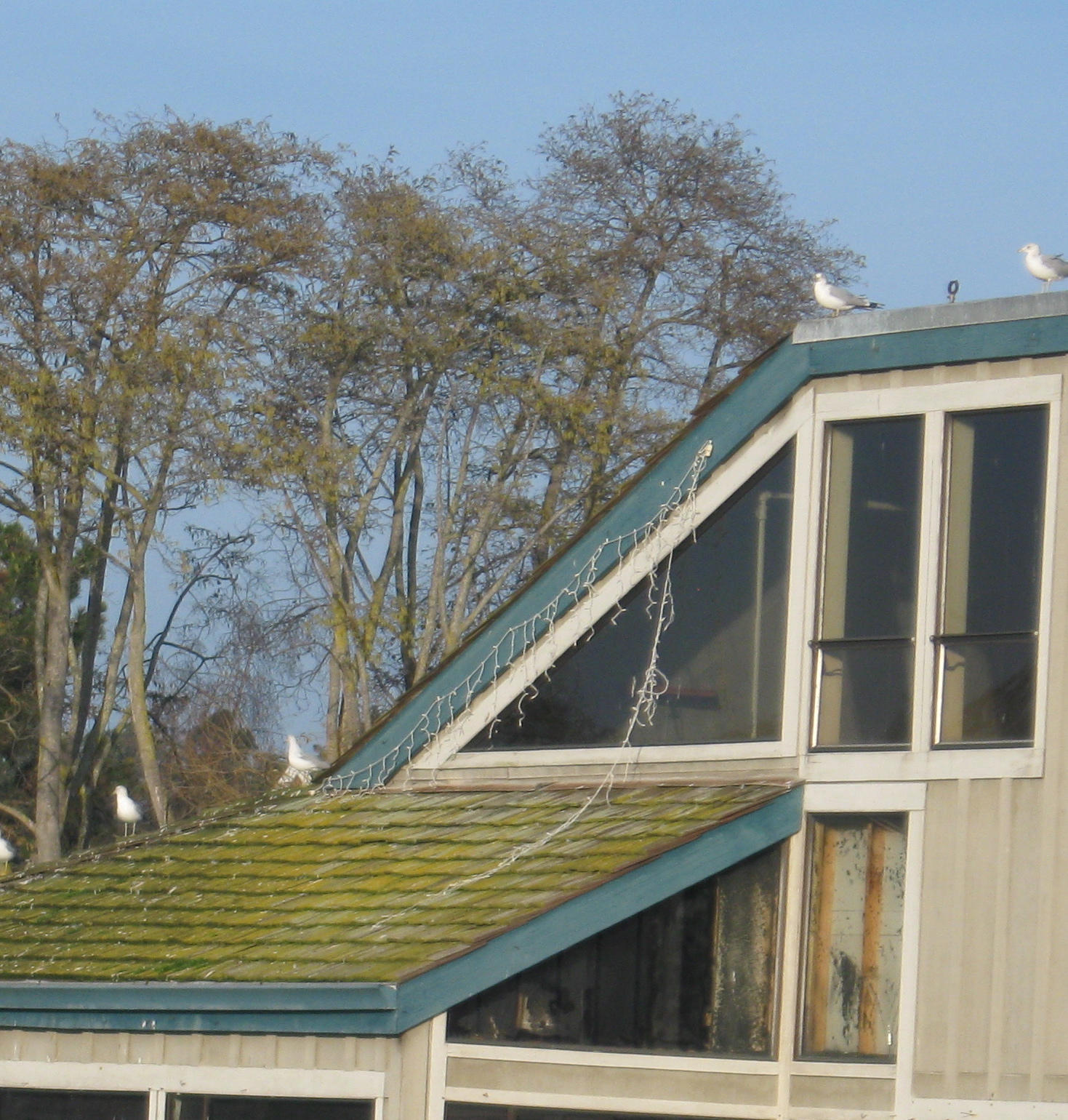
The place needs a facelift, better planning, and some marketing.  This property changed hands in 2001 and, ever since, the shopping center has  gone downhill.  The neglect is hard to miss:  dry rotted boards painted over;  rusted flashing and lighting; slapdash touch-up painting; remains of ancient Christmas-light wires dangling from trim; a stairwell adorned with cobwebs leading to uninviting upstairs hallways that discourage office rental; minimal landscape care and tired courtyards.

This problem is more than a downturn in the economy.  Compared to asking prices of $18 to $29 a square foot for other commercial leases in Alameda neighborhood centers, the Landing owners are asking for $33 a square foot.  What gives?  Do the anchor tenants subsidize the vacancies so the owners don’t need the money from the residents of Harbor Bay?  The landlord’s bottom line is at the expense of the community.

Dangling holiday lighting.

The city has recently helped the nearby Harbor Bay Business Park attract a hotel and other large tenants there.  Yet, Harbor Bay Landing LLC turned down the city’s offer of assistance.  There appears to be no effort to capitalize on the increased opportunity for shopping and dining at Harbor Bay Landing.  Hardly neighborly.

A community pride of ownership is needed at the Landing.  Alameda needs a business neighbor that demonstrates a commitment to the community.

Originally published in the Alameda Sun

________________________________________________________________

Follow-up stories about Harbor Bay Landing:

Alameda Patch:  Vacancies at Harbor Bay Landing Draw Criticism

The Island:  Harbor Bay Landing vacancies blamed on rising rents, lack of upkeep

sfgate:  Harbor Bay Landing:  What Should Be There?


Posted in Economic Development, Quality of Life | Tagged | Comments Off on Sad Side Show at Harbor Bay Landing

Alameda Theater Offers Independent Films

Alameda Theater on Central Avenue at Oak Street

Next time you want to see an independent film at a theater, look in Alameda first.  The Alameda Theater has been showing independent films, and you might not have noticed.

Some of you may be asking, what exactly is an independent film?  It’s a film that’s not produced by the large Hollywood film studios or distributed by the major distributors.  Independent films tend to have strong, original and/or controversial storylines or unique visual perspectives.  They are not budgeted for big movie stars, and less corporate oversight allows a new artist’s or filmmaker’s original vision to stay intact.  Often it’s the director who draws audiences.  I have found these unique films to be exceptional, thought provoking, and often just plain beautiful to see.  Starting at film festivals, many of them receive the acclaim of critics and win awards worldwide.

During the fall, the Alameda Theater showed over a dozen independent films.  They are now bringing in the new year with the psychological horror thriller “Black Swan” about a ballerina’s quest for perfection while dancing the dual roles of the White and Black Swan in the ballet Swan Lake.  Next up will be the highly praised “King’s Speech,” a powerful, hilarious, and deeply moving story about how King George VI, the father of the current Queen Elizabeth, overcame his stuttering problem to give a speech at a critical juncture in modern history.

Because independent films are typically shown only at selected theaters (such as a Landmark or Cinéarts theater), many of us have been choosing the venue before looking at the listings.  Now we can turn first to our independently owned Alameda Theater.  For those who don’t know which films are independent, the Alameda Theater will tell us.  Whether you’re looking online, at the marquee, or in the newspaper, it will clearly indicate “(Indie)” after the title

While mass-marketed movies offer enjoyment, we’re lucky the Alameda Theater is giving space to independent films.  But how often they show these films will depend on viewership.  The theater can do its part, but it’s up to us to do ours.  If you know a particular Indie movie you think will attract a large audience, please let the theater know.  Use their “contact us” page at <www.alamedatheaters.com>.  You can even buy your tickets online.

Showing independent (Indie) film "Black Swan"

Look for the Indie film marker at the Alameda Theater the next time you’re in the mood for a movie.  You’ll not only be impressed, you’ll find yourself monitoring the theater’s listings to see more.

Originally published in the Alameda Sun

Posted in Quality of Life | Tagged , | Comments Off on Alameda Theater Offers Independent Films

Get More Involved with Alameda in 2011

Make your New Year’s resolution local.

Some people can tell you intricate details about state and national politics.  Some stay abreast of international issues.  They dedicate hours to gathering information and forming opinions.  But ask them who is on their city council, what issues face their city, or what is happening in their town, and they are at a loss for words.

It’s true that in some communities it’s difficult to find out what’s happening locally.  Not so here.  In Alameda we have local media outlets that give us information about our town.  We are fortunate we can watch city council, planning and school board meetings on cable channel 15 or online.  Meetings are also archived on the city’s website.

If your resolution is to become more involved and aware of civic affairs, there is no need to feel intimidated while you’re getting up to speed.  There are plenty of people who would be more than willing to bend your ear on any local issue.  By staying tuned-in here, you can help guide the city’s future and, ultimately, won’t have to rely on others to decide whom to vote for in the next local election because you’ll have first-hand knowledge.

What goes on at city hall affects your neighborhood and your local merchants.  It isn’t enough to market a shopping district, there also needs to be support to keep merchants going, especially during the first crucial years.  Let’s resolve to keep our favorite local places alive and to find more favorites in the New Year.

You’ll never know what you’ll find by taking a simple stroll through Alameda’s business districts.  We can enjoy local restaurants, entertainment, cultural events, and shopping without leaving town and fighting traffic. The activity, the people, the finds, and even the occasional window-shopping offer surprises that can even be romantic.  Plus, taking regular strolls can be a good way to start that exercise plan you’ve resolved to start in years past. Make our business districts a walking or cycling destination.

Bring in the New Year with a touch of it all.  On New Year’s Eve there’s going to be a party at the Alameda Theater! Good food and live on-stage entertainment with room to dance.  Who knows … you may even meet some of your local representatives there.

Originally published in the Alameda Sun

Posted in City Hall, Quality of Life | Tagged | Comments Off on Get More Involved with Alameda in 2011

A Frank Assessment

The end of the year is a time of transition for the City of Alameda.  Frank Matarrese leaves the city council, and Rob Bonta steps in.  Mayor Beverly Johnson and Marie Gilmore swap seats.  It’s more than musical chairs, the duties and responsibilities are enormous and challenging.

Our elected council and mayor oversee the activities of the city from approving a budget of about $208 million, to establishing broad policies and objectives, to covering personnel and legal issues.  They sit on the Alameda Reuse and Redevelopment Authority (ARRA) and the Community Improvement Commission (CIC).  For this, they are paid $50 a meeting.

There are about 40-50 meetings a year, some lasting to past midnight, and councilmembers must come prepared to tackle each item on every agenda.  They must listen to comments from staff, experts and the public, synthesize what’s been said into an understandable motion, and then quickly decide which way to vote.  After eight years of service on the council (during which he missed only two meetings), outgoing Councilmember Frank Matarrese notes:  “Being on the city council is not as easy as it looks.  Seemingly easy issues always turn out to be complex, and there are unintended consequences for almost every action.”

Besides the formal meetings, councilmembers meet and hear from their constituents.  For many this is the hardest, but best part of the job.  Frank’s parting advice to us is “to stay interested and informed and to take information from as many sources as possible. Don’t be afraid to ask your representatives directly.  In fact, do that first when something really bothers you about the city.  We are lucky in Alameda that our council is so accessible.”  He adds that face-to-face communication is the best, which is the reason he held Town Hall meetings.

Everyone hopes to leave office with something to show for their efforts.  Frank is no exception.  He leaves the council feeling it was a rewarding experience:  he had some part in getting a new library, restoring the theater, establishing long-term plans for city finances, and helping the environment.  While our city is financially stable at this moment, Frank adds,  “There are still huge economic hurdles, but there are opportunities too.  I wish the next council the best.”

I’ll miss seeing Frank in action.  He excelled in his duties.  His last meeting is December 21.  Then Rob Bonta will take his place.  Bonta brings an impressive resume.  I hope he has the kind of personal engagement with the community that I came to admire in Frank. Best wishes Frank, and thanks to all who serve, contribute and sacrifice as our elected leaders.

Originally published in the Alameda Sun

Posted in City Hall, Elections | Tagged , | Comments Off on A Frank Assessment